


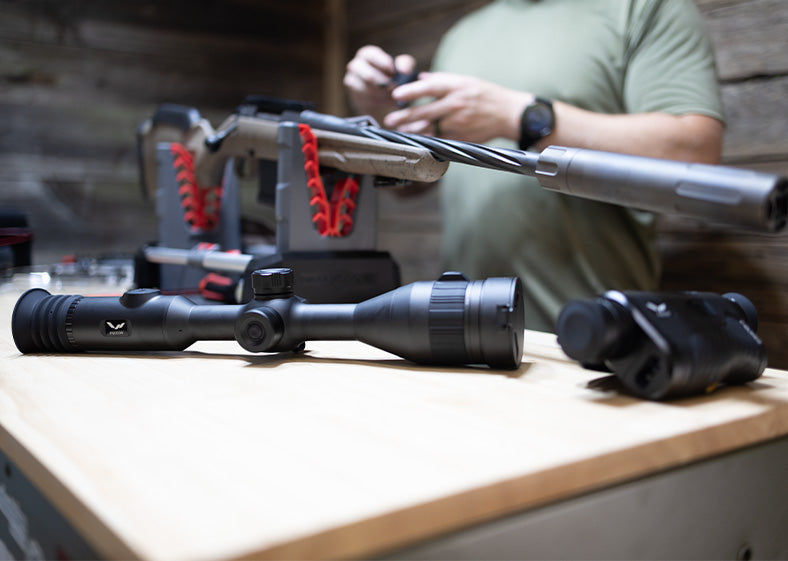
The M1V2.0-650L is built for hunters who want a thermal riflescope that combines a clear 640-class image, built-in laser ranging, simple controls, and a field-ready housing. Its role is straightforward: reduce distance guessing and help hunters make better decisions after dark.
This article focuses on real hunting use, not technical language for its own sake. Always confirm your state and local hunting regulations before using thermal optics at night.
Why Built-In LRF Matters
At night, distance is easy to misread. A coyote at the far edge of a pasture or a hog crossing a field can look closer than it really is. A built-in laser rangefinder gives a quick distance reference without forcing the hunter to switch to a separate handheld device.
Rangefinder readings can vary with target reflectivity, angle, weather, dust, rain, and background conditions. The LRF is a decision-support tool. It does not replace a verified zero, safe backstop awareness, or local legal requirements.
Image and Handling
The M1V2.0 is designed around a practical hunting workflow: scan, identify the heat signature, confirm distance, and make a responsible decision. The control layout should be learned before the hunt, especially power, zoom, palette, LRF, recording, and menu navigation.
Use lower digital zoom for scanning and target acquisition. Higher digital zoom is best reserved for closer inspection from a stable rest. As with any thermal optic, image detail depends on weather, humidity, terrain, target size, and background temperature.
Field Scenarios
Hog Hunting at Dusk or After Dark
In open pasture or near a feeder, a thermal scope can help locate heat signatures that are difficult to see with the naked eye. The LRF gives a distance reference before the hunter decides whether a shot is safe and legal.
Predator Control
Coyotes often move quickly and appear at uncertain distances. The combination of thermal detection and built-in ranging helps reduce guesswork, especially when calling over uneven ground or large fields.
Wet Weather and Ranch Use
Rain, fog, and damp ground are common realities for night hunters and landowners. The M1V2.0 is built for normal wet-weather use, but it should not be submerged or pressure-washed. After a wet hunt, wipe the unit dry and inspect the lens area before storage.
Color Palettes and Reticles
Most hunters will spend most of their time in White Hot or Black Hot. Additional palettes can help in certain backgrounds or for recording, but simpler modes are often easier to read when the shot matters.
|
Mode |
Best Use |
|
White Hot |
General scanning and most night-hunting situations |
|
Black Hot |
Bright backgrounds, snow, or scenes where White Hot creates glare |
|
Highlight |
Light brush or cluttered backgrounds where edge contrast helps |
|
Low Light |
Long observation sessions where eye fatigue matters |
|
Pseudo-color |
Recording, teaching, or comparing heat patterns |
Zeroing and Profiles
A thermal scope should be zeroed carefully before hunting. Use a suitable thermal target and confirm the zero at the distance that matches your rifle, cartridge, and expected field use. Saved profiles are useful if the scope is used across different rifles, loads, or zero distances.
1. Mount the scope securely and confirm eye relief.
2. Use a suitable thermal target at your chosen distance.
3. Fire a controlled group and adjust reticle position to match point of impact.
4. Save the profile with a clear name.
5. Confirm zero before any hunt where the scope will be used.
Water Resistance: Practical Boundaries
A clear way to say it: the M1V2.0 is rain-ready, not submersible. It is intended for normal field exposure such as rain, snow, fog, splashes, and damp conditions. Do not drop it into water, leave it in standing water, or wash it with high-pressure water.
Who Should Consider the M1V2.0-650L
• Hunters who want a 640-class thermal scope with built-in LRF
• Hog and predator hunters working open fields, pasture, and ranch land
• Users who prefer practical controls over complicated menus
• Buyers who want a strong feature set without carrying a separate rangefinder
FAQ
-
Can the M1V2.0 be used in rain?
Yes, for normal wet-weather hunting conditions. It is not designed for submersion.
-
Does thermal work through brush?
It can help detect heat signatures in light cover, depending on conditions. It does not see through solid objects or dense terrain.
-
Is the LRF always exact?
No. Ranging performance depends on reflectivity, angle, weather, and target conditions.
-
What is the warranty?
Falcon products are covered by a 5-year warranty with no product registration required. Keep your proof of purchase for service.
Bottom Line
The M1V2.0-650L is best positioned as a practical mainline thermal riflescope for hunters who want image clarity, built-in ranging, and rain-ready field use. Its strongest message is not hype. It is confidence built from fewer separate devices, fewer distance guesses, and a clearer workflow in the dark.
CTA: Shop M1V2.0-650L | Compare Falcon Thermal Scopes | Read the Falcon Warranty


Leave a comment
This site is protected by hCaptcha and the hCaptcha Privacy Policy and Terms of Service apply.